
Many of the mobile home park “harassment and eviction” stories that make the news start with a state inspector holding a clipboard.
The story is familiar. A mobile home park resident, says the park management is threatening eviction over a shed, a porch, or some stored belongings. A reporter frames it as a struggling resident versus a greedy landlord. An advocacy group steps in as the residents’ champion and connects the dispute to its larger agenda, usually rent control.
What these stories rarely explain is the state process that set the dispute in motion. In California, the Department of Housing and Community Development (HCD) inspects mobile home parks lot by lot. It cites residents for code violations on their own spaces. And if one or a small number of residents refuse to fix those violations, state law puts the park’s operating permit, and every other resident’s housing, on the line.
Here is how that process works, and why it so often ends with a park owner in the role of villain.
What An MPM Inspection Is
The Mobilehome Park Maintenance (MPM) inspection is a routine, state-mandated health and safety check, not a park owner’s initiative. Health and Safety Code section 18400.1 requires enforcement agencies to enter and inspect parks for compliance with the Mobilehome Parks Act.
The state’s goal is to inspect at least 5 percent of California’s approximately 4,500 mobile home parks every year.
HCD prioritizes inspections for parks with verified health and safety complaints, no MPM inspection in the last seven years, or with no recent permit history.
Everyone Gets Weeks Of Warning
No one is ambushed. HCD posts a Notice of Planned Inspection in the park, and the inspection takes place 30 to 60 days after that posting date. At least 30 days beforehand, every resident gets an individual letter from HCD.
Residents also receive HCD’s Resident Information Booklet (form MP 200). It lists the most common violations, with code references, and urges residents to inspect their own lots first, noting that many problems are easy to fix before the inspector arrives. Park operators get a parallel Operator Information Booklet (MP 202) and a pre-inspection conference with HCD.
The Inspector Looks At The Outside, Not Inside The Home
The inspection covers two things: the park’s common areas, buildings and utility systems, which are the park owner’s responsibility, and each individual lot. Under normal circumstances HCD inspectors do not enter homes. An inspector may ask to come inside only if something visible from outside suggests a hazard, and the resident can refuse permission.
On the lots, inspectors look at utility connections, sheds and other accessory structures, setbacks from lot lines, extension cords, fire hazards and rubbish. According to HCD, residents are most often cited for:
- Accumulated garbage, rubbish or combustible material (1,382 citations in the first half of 2026, the most common by far)
- Unapproved water connectors (647)
- Appliances kept outside (601)
- Extension cords used as permanent wiring (587)
- Storage sheds built within 3 feet of the lot line (572)
These are not cosmetic complaints. Combustible debris, improvised wiring and structures crowding the lot line are fire risks in a community where homes sit a few feet apart.
Park owners get cited too. In the same period, the top park violations included exposed live electrical parts (771), unmarked lots (761) and equipment not approved for wet locations (450). Owners must fix those on the same timeline as residents.
The Citation Goes To The Resident, Privately
After the inspection, each resident with problems on their lot gets a Notice of Violation (NOV) in the mail. It lists each violation, the code involved and how to look up the fix in the information booklet provided by HCD.
The park owner is not told. HCD does not share residents’ violations with park management after the initial inspection, unless a violation is an imminent threat to life, health or safety. The idea is to protect residents’ privacy and give them a fair chance to fix things on their own.
That privacy has a side effect: the park owner is kept out of the loop during the very period when a resident could most easily resolve the problem.
60 Days To Fix it, Then A Second Look
Under current rules, the NOV gives residents and the park 60 calendar days to correct violations. That window grows to 90 days starting January 1, 2027, according to HCD’s current booklets. HCD can grant extra time for good reasons such as weather, illness, the availability of repair workers or money.
When the correction period ends, HCD reinspects. Most residents have done what was asked: in the 2023 inspection cycle, about 82 percent of violations were corrected, according to HCD data.
For the rest, HCD issues a Final Notice of Violation. Only now does the park management get a copy of the resident’s violations and it is noticed that park management is now responsible to gain compliance. The resident gets 30 more days, and so, in practice, does the park.
Park management steps in to work with residents to gain compliance. Typically HCD will grant additional time to comply if management is working with the resident to correct the code violations.
MPM inspection timeline · 8 steps:
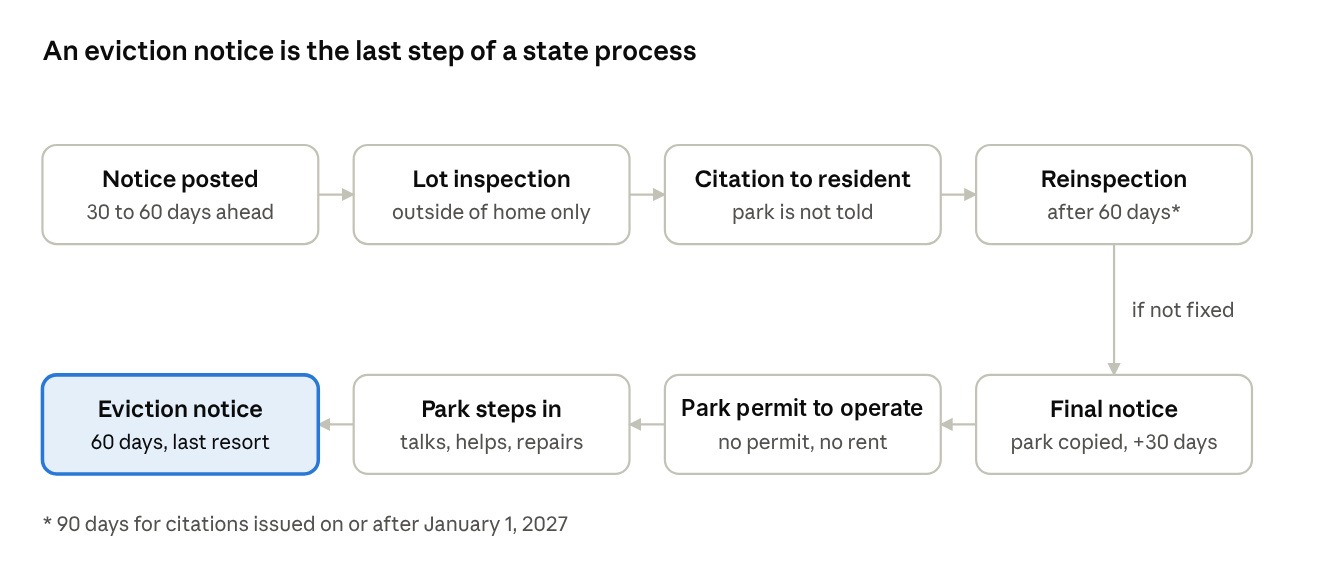
Most cited residents have complied at reinspection; only those who still haven’t fixed their violations move down the bottom row.
When A Resident Won’t Comply, The Park’s Permit To Operate Is On The Line
This is where the headline-making conflict can begin. A park cannot operate, or collect a dollar of rent from anyone, without a state Permit to Operate. HCD’s operator booklet says reinspections continue “until all park and resident violations have been corrected,” and that failure to abate all violations may lead to suspension of that permit.
The practical consequence is stark. Under state law, once a permit is suspended it becomes illegal for the park to charge or accept rent for any lot. As of June 30, 2026, HCD listed 39 parks with suspended permits.
HCD has other tools for dealing with a recalcitrant resident, including court action and referral to the district attorney, since willfully violating the Mobilehome Parks Act is a misdemeanor. But the park owner is ultimately responsible for health and safety, HCD can threaten to suspend the park’s permit until a resident’s violation is fixed. The park management is put into a position to make sure the resident mobile home owner complies with notices. In a few cases, the tenant refuses to comply.
That leaves the park management with few choices. It can:
- Talk with the resident and offer help, such as time, referrals to contractors or repair programs, or a hand clearing debris.
- Begin termination of tenancy. California’s Mobilehome Residency Law (Civil Code section 798.56) allows it when a homeowner fails to comply with a state law or regulation within a reasonable time after notice. The resident gets at least 60 days’ notice.
The rare instance when the second option becomes necessary is the one that ends up on the evening news. But it is the last step in a long state process: a posted notice, a personal letter, a booklet, an inspection, a private citation, 60 days to fix it, a reinspection, a final notice and 30 more days. The eviction notice is not where the story begins. It is where a state-imposed clock runs out.
Evictions Are Not Only Rare – But A Bad Outcome For The Park Owners, Too
The stock narrative assumes park owners are eager to push residents out. The economics point the other way.
In a typical mobile home park, residents own their homes and rent the land underneath. When a tenancy ends, the owner or the mobile home may move it out of the park or sell it to a qualified buyer. If this does not happen the home may be abandoned and a lien sale is noticed. Some abandoned mobile homes may be deemed a health and safety risk due to violations, age, and overall lack of maintenance. In this case, the mobile home is removed from the park at the expense of the park owner.
Evictions also take time, cost money in legal fees and sour the atmosphere in a close-knit community. Park management avoids eviction if at all possible because it is time-consuming, expensive and divisive within the community.
Meanwhile, the residents who fixed their violations, the large majority, have a stake too. If one or two holdouts cost the park its permit to operate, everyone’s housing becomes uncertain.
How The Story Gets Told – And What Gets Left Out
Reporters understandably gravitate to the most sympathetic face in the conflict: a resident facing the loss of a home. Too often, though, coverage runs on a victim-and-oppressor template. The resident’s account is taken at face value, the park owner gets a line or a “declined to comment,” and the state agency that issued the citations goes unmentioned.
Advocacy groups on the left often step into these disputes as self-appointed resident advocates. Some use them to argue for rent control and other policy goals that have little to do with whether a shed sits too close to a lot line.
Readers can see past the template by asking a few questions:
- Was this park recently inspected by HCD or a local enforcement agency?
- What exactly was the resident cited for, and when?
- How much time has the resident had to fix it, and were extensions offered?
- How many residents were cited, and how many fixed their violations?
- Is the park’s Permit to Operate at risk?
The answers often turn a story about a heartless landlord into a story about a handful of residents who have not addressed state safety citations, and a state law that makes the park owner the enforcer of last resort.
The Bottom Line
The next time a mobile home park dispute makes the news, look for the inspection behind it. In most parks, most residents fix what the state cited and the process ends quietly. The conflicts that do surface usually involve a small number of residents who did not correct violations on their own spaces after months of notice.
State law then hands the problem to the park owner and attaches a penalty no one wants: losing the permit to operate that keeps the whole community operating. The resulting eviction notice can look like an overreaction from the outside. More often it is the final step of a state enforcement process that started with a notice posted on the clubhouse wall.