
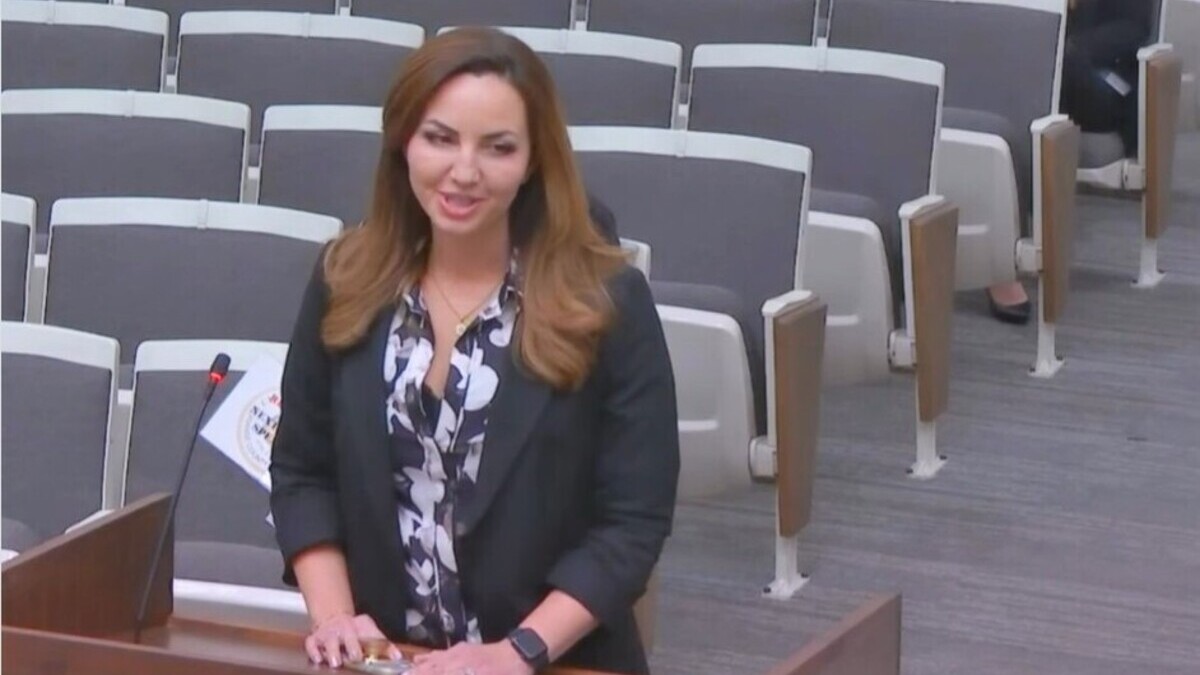
NOTE TO READERS: A week ago, OC Independent e-mailed Brandy Romero a set of questions related to issues examined in these articles, seeking her response. We sent the questions to her work e-mail on June 3, and again on June 4. On June 7, we e-mailed them to her via the “Contact Us” page on her candidate website (which states “Ask Us Anything”). We received no responses. We will incorporate her responses if and when we receive them.
NOTE TO READERS (June 10, 2026): In an Instagram video, Romero claimed she never received our e-mails. None of our e-mails bounced back as undeliverable. In any case, we sent her the questions via an Instagram message, and she promised “I will get back to you this week with a response.”. We will hold off on publishing Part 2 until the end of the week.
NOTE TO READERS (June 14, 2026): We did not receive any responses from Romero last week and so are publishing Part 2. We will incorporate her responses if and when we receive them.
In part 1, we investigated Romero’s claims to business success and compared them to the evidence available in the public record.
In June 2025, Mayor Dan Slater appointed Romero to the city’s Park Planning and Community Events Commission. This provides Romero with an official city title she can use in her ballot designation; ‘Orange City Commissioner’ sounds a lot like ‘’Orange City Councilmember.’
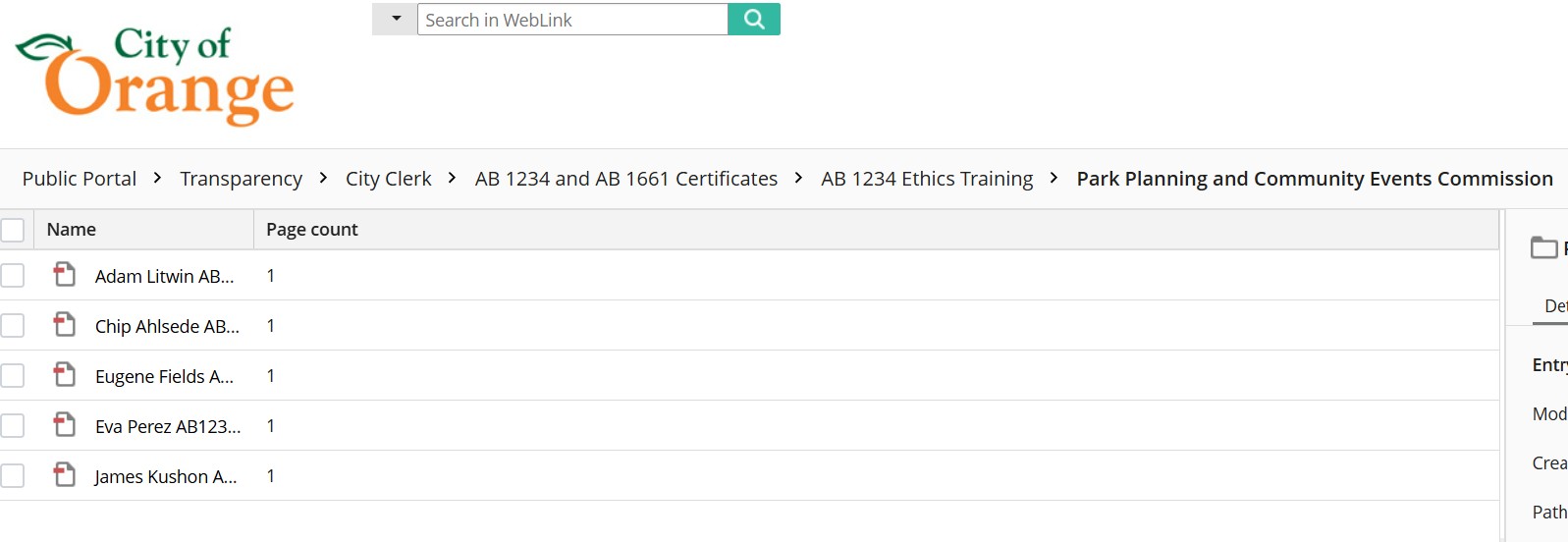
Under a state ethics law known as AB1234, local government, elected officials and certain types of commissioners, such as Romero, are required to certify that they have enrolled in and undergone ethics training within six months of being appointed to office.
Romero had until the end of 2025 to complete ethics training.
According to City of Orange records, Romero has failed to do so. In fact, she is the only member of the city Parks commission has not complied with AB 1234 – which puts her in violation of state law.
Supports “Vacant Property Tax”: A Potential Magnet For Home Squatters
Council candidates often begin attending and speaking at city council meetings after becoming candidates, and Romero is no exception. For neophytes, it’s an opportunity to gain public exposure and display some grasp of city government.
For Romero, it helps address criticism from detractors who point to her lack of experience, to which Romero responds that she is a “quick study” – an implicit admission of her lack of experience that was echoed by Mayor Dan Slater in his endorsement.
However, Romero’s embrace of dubious public policies calls that claim into question.
The Orange City Council is currently grappling with a stubborn, unprecedented structural deficit that threatens the city’s financial solvency, and they are debating a number of tax measures to cover that deficit, including a 1% sales tax increase.
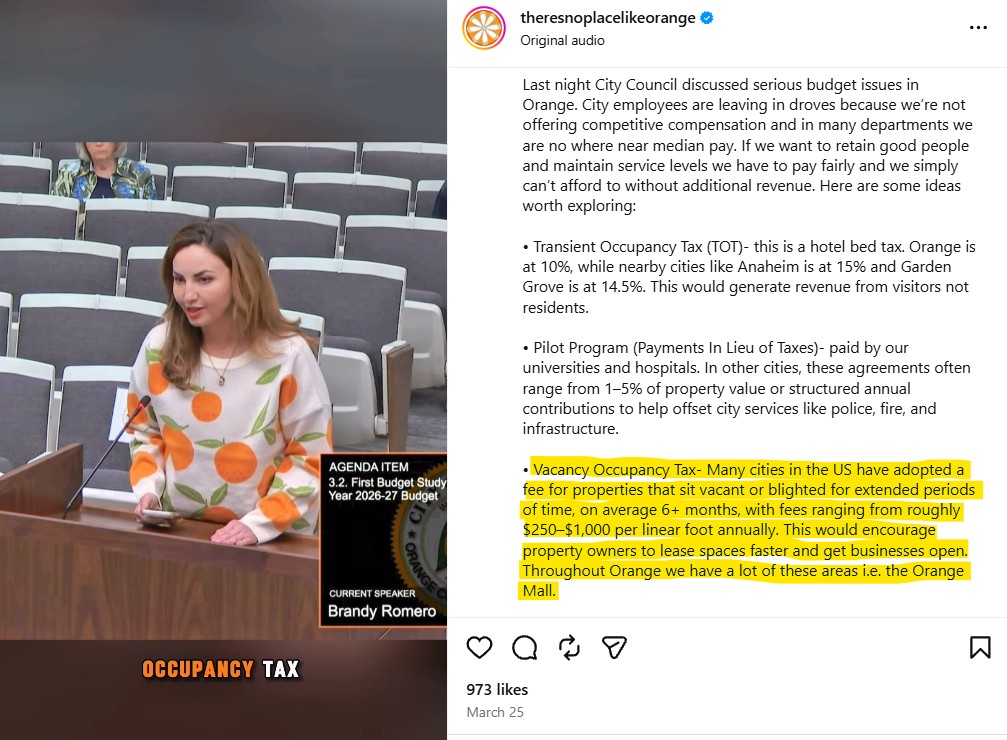
Romero, for her part, has urged the council to impose a tax on vacant properties. This is exactly what it sounds like: the owners of vacant or unoccupied or unused properties will be hit with a punitive tax. The idea is the punitive nature will incentivize the property owners to find some economic activity or use for the property.
However, the many flaws of a vacant property tax outweigh the notional advantages.
A vacant property tax sounds tidy in theory: charge owners who leave homes empty, and the market will magically produce more housing. In practice, it is a blunt instrument that often creates more friction than relief. The hardest part is not the idea itself, but the bookkeeping of deciding what counts as “vacant,” who gets exempted, and how long a property must sit unused before the tax kicks in. That administrative gray area invites disputes, loopholes, and uneven enforcement, which means the policy can end up punishing some owners while others slip through untouched.
There is also a fairness problem. Not every vacant property is a speculative choice; some are caught in probate, renovation, divorce, insurance claims, or long permitting delays. A tax that does not distinguish between a luxury condo left empty for investment and a family home stuck in legal limbo can feel less like a housing solution and more like a penalty for circumstance. And when governments do not design the rules carefully, owners respond predictably by gaming the system, making token occupancy claims, rushing half-finished uses, or passing the cost into rents, sale prices, or deferred maintenance.
A vacant property tax rests on the idea that there are all these property owners simply sitting on vacancies and making no effort to find tenants, and so they the city to goose them with a taxation cattle prod.
There’s also the unintended consequences: implementing a vacant property tax would require Orange to create a database – accessible to the public – of vacant properties. Such a registry can easily be exploited by squatters, who would know exactly where every vacant property in orange is located – a property owner’s nightmare.
Add in the necessity of dedicated, salaried staff necessary to implement and administer a vacant property tax scheme, and any revenues would be negligible in the context of Orange’s yawning budget crisis.
Mike Alvarez is a life-long Orange resident, businessman and former Orange City Councilman. His business owns multiple properties in Orange and elsewhere, and he was critical of a vacant property tax as a policy response to the city’s budgetary crisis.
“ I think it’s counter-productive,” said Alvarez, who has not endorsed any candidate in the District 1 race. “We need to attract more tax-generating businesses to Orange, and that’s not going to happen if we continue to adopt laws just to increase City fees”
“ In the long run, Orange needs more revenue, increasing fees and taxes sends the wrong message, I’d prefer incentivizing property owners to clean up their properties, increasing penalties has never cured any blight in our city”.
In a Facebook post, Romero supports imposing a vacant property tax on property owners at the Village at Orange Mall (i.e. the Orange Mall) – which suggests a distressing lack of understanding.
For example, consider the portion of the Mall property inhabited by the old Sears. Sears doesn’t own the land, but controls it under an agreement with the property owner – control Sears retains until 2049. In fact, the property owner literally has no control over what Sears does and doesn’t do with it. Would Romero tax them because the Sears Auto building has been standing empty for years?
What about TRC – the company that owns most of the mall proper and recently demolished the interior mall spaces because market conditions were making it impossible to find decent tenants. Instead of spurring TRC to lease space, a vacant property tax would have almost certainly caused them to demolish the interior mall space years earlier – achieving the exact opposite of the tax’s ostensible policy purpose.
Misguided Budget Hawk
Romero is the chair of the city’s Park Planning and Community Events Commission, whose mission is to support recreational opportunities for Orange residents.
The city’s ongoing budget crisis has reduced or eliminated funding for recreational opportunities across the board. One of those was the summer aquatics program at historic Hart Park, which generations of Orange children have enjoyed for decades.
The eight-week program was typically budgeted around $420,000 and included part time staff costs for approximately 45 seasonal staff, a full-time Recreation Coordinator, required certifications and trainings, equipment, supplies, and uniforms.
The city was actually planning to discontinue the summer aquatics program altogether, but due to strong community demand to continue it, instead issued an RFP for an outside vendor.
This year, the city was able, by using a private vendor rather than city employees, to restore the aquatics program to pre-2025 levels for a little more than half the cost: $250,166.40.
Most would cheer this as welcome and innovative: restoring a cherished community recreational at a significantly lower cost.
Instead, Romero chastised the city council. Speaking at the March 24 council meeting, Romero admonished the council:
“At the last council meeting we made more than $700,000 in purchases. It’s very painful for us, as the residents, to see that. Going forward, when we decide to approve something like $250,000 for Hart Park pool or $400,000 for Meridian [mobile] barriers, we would like to know what we are giving up, instead of purchasing those items.”
This is an odd statement – especially from the chair of the Park Planning and Community Events Commission. The council engaged in a long and thorough discussion of the contract, and there’s no evidence anything was “given up” in order to rescue the city’s aquatics program.
Trouble With State Campaign Regulators
This spring, Romero was dinged by the California Fair Political Practices Commission – the body that enforces state campaign finance and disclosure laws – due to Adwatch submissions indicating that you failed to include the proper advertisement disclosure on the Instagram page operated by the committee Brandy Romero for City Council 2026.”
You can read the FPPC letter here.
Romero subsequently added the necessary disclosure and took an FPPC course on campaign advertisements, and as a result the FPPC took no further action.
First-time candidates like Romero sometimes commit these kinds of rookie mistakes. But it also seems part of a pattern of becoming ensnared in the consequences to ignoring or not thinking through rules and consequences. Romero promotes herself as a savvy, knowledgeable, successful business person who can hit the ground running and right the City of Orange’s imperiled ship of state.
She’s the chosen successor of Councilwoman Arianna Barrios, and is also endorsed by Mayor Slater, Councilwoman Ana Gutierrez and the Orange Firefighters Association. She presumably has a campaign consultant. It’s reasonable to assume she is receiving campaign guidance and advice from one or all of these sources.
Which makes the mistakes and faux pas and disregard for laws and rules all the more puzzling.
Romero publicly claims to own OEM Materials, when the public records says she does not.
She claims to be a successful businesswoman, when the public record shows her business entity has been suspended by the Franchise Tax Board, most likely for failure to pay taxes.
She has $20,000 to put into her campaign, but she fails to pay her $5,375.07 property tax bill or the $2,897.68 she owes Synchrony Bank. In fact, Synchrony is suing over that failure to pay.
Taken against the backdrop of a city on the brink of financial insolvency, it is valid to question whether council candidates who struggle to put their own financial houses in order are best equipped to navigate Orange through its budgetary storm of the century.
EDITOR’S NOTE: A previous version of this article erroneously reported that Romero had been appointed to the Park Planning and Community Events Commission by Councilwoman Arianna Barrios. Romero was appointed by Mayor Dan Slater. We regret the error.