
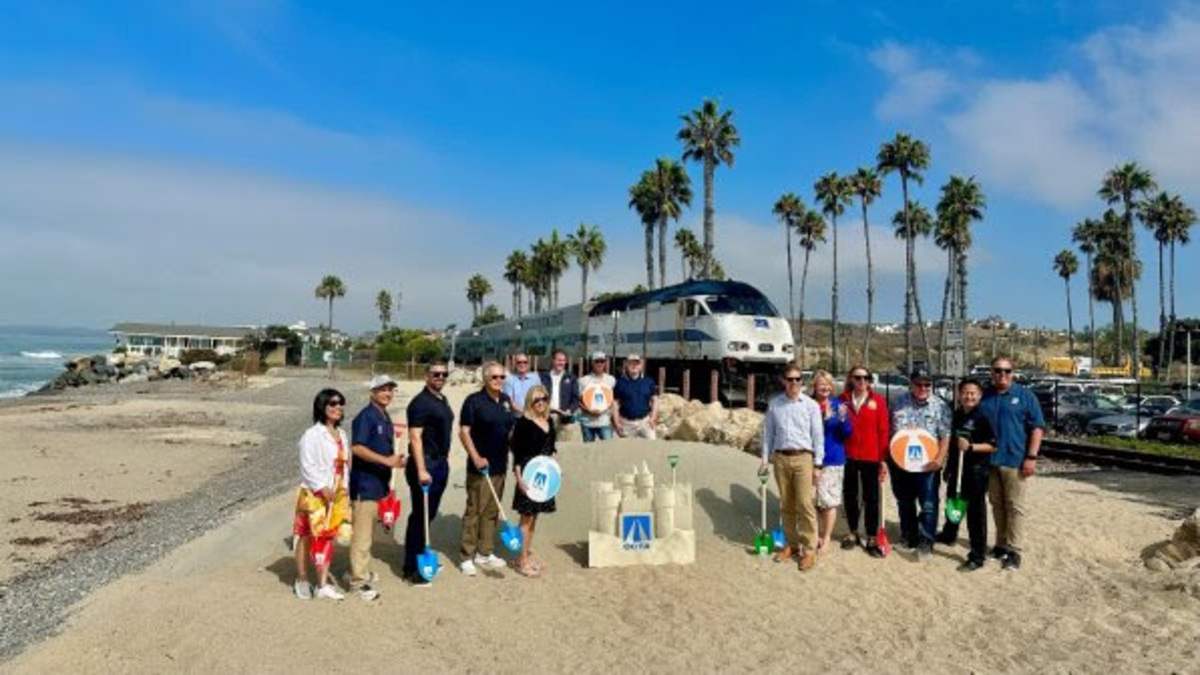
The Orange County Transportation Authority (OCTA) has begun placing sand along the San Clemente shoreline as part of an emergency effort to protect the coastal rail corridor, a vital transportation link for passengers, freight, and the military.
Over the next week, more than 300 truckloads — about 3,400 cubic yards — of sand from a Palm Springs quarry will be delivered to North Beach. The quarter-mile stretch of sand is designed to reinforce the rail line while longer-term stabilization work continues.
The initial placement marks the beginning of a larger plan that could eventually add up to 540,000 cubic yards of sand along the San Clemente coast, pending additional sand sourcing and state and federal permitting approvals. The cost of the current effort is about $900,000.
“I want to thank the collective effort of agencies and leaders at every level of government who helped make this initial sand placement a reality,” said OCTA Vice Chair Jamey M. Federico, also a Dana Point Councilmember. “Reaching this milestone was possible because of our federal and state partners, multiple agencies including the Federal Railroad Administration, the California State Transportation Agency, California Transportation Commission, the Coastal Commission, the City of San Clemente, and the community.”
Later this month, work will also begin near Mariposa Point. That project includes restoring the San Clemente Pedestrian Beach Trail and building a 1,400-foot catchment wall to shield the rail line from debris falling from the hillside above. Completion is scheduled for summer 2026.
The sand effort is part of a broader $310 million package of emergency projects to reinforce four of the most vulnerable areas along San Clemente’s seven-mile coastal rail stretch. About 95% of the work involves sand replenishment, with the remaining 5% consisting of hardscape protections such as boulders.
The rail line, in operation for more than 125 years, has faced repeated closures over the past four years because of bluff erosion on city and private property. Earlier this year, OCTA completed the first phase of emergency work — placing large boulders, or riprap, along the track to prevent erosion. Passenger service was temporarily halted during that six-week project but has not been interrupted during the current sand placement.
In addition to the immediate stabilization projects, OCTA is conducting a Coastal Rail Resiliency Study to consider longer-term solutions for the next 30 years. The state is also preparing a separate study that may include evaluating whether the line should eventually be moved inland.